My Moon Phase Pro
- 4.8
- Rating
- 10.00K
- Installs
- $3.99
- Price
 Analysis by App-foxy
I usually give moon-phase apps a few days before deciding whether they are genuinely useful or simply attractive calendars that I forget to open. My Moon Phase Pro made a better first impression than most because it gives the lunar cycle a clear purpose: checking where the moon is in its cycle, planning around a full moon or blue moon, and keeping a simple lunar calendar close at hand. It is a focused weather app from JRustonApps B.V., but it does not try to compete with a full forecast service.
That distinction matters. If I want rain alerts, hourly temperatures, radar maps, wind warnings, or pollen information, I reach for a conventional weather app. Here, the appeal is narrower and calmer. The app is built for people who care about the moon itself, whether for photography, gardening routines, outdoor plans, personal observation, or simple curiosity. After using it as a recurring reference rather than a one-time novelty, I found that its value depends less on how often I open it and more on whether lunar information actually fits into my habits.
What makes the first week appealing
The first few days are easy to enjoy because the subject is naturally visual. A changing moon gives the app a built-in sense of progress: each visit answers a small question about what I can expect to see in the sky. The store summary places the emphasis on the lunar calendar, blue moon, and full moon, and that focus comes through in the way the experience feels. I am not sorting through unrelated weather panels or trying to interpret a crowded dashboard. I am checking one particular cycle.
You May Also Like

 Pandora - Music & Podcasts
Pandora’s Music Is Easy to Start, but Harder to Recover
Pandora’s strength is its low-effort path from a seed to a station. Its weak spot is how much confidence it asks you to place in connection, setup, and quiet recovery.

 AccuWeather: Weather Radar
AccuWeather Review: A Quick, Clear Forecast for Everyday Decisions
For everyday plans, the best forecast is the one you can understand quickly. AccuWeather makes rain timing, radar, and local conditions easy to act on, with a few trade-offs.

 Hill Climb Racing
Why Hill Climb Racing Still Turns Crashes Into One More Run
A tiny car, a bumpy hill and one more upgrade: Hill Climb Racing keeps resurfacing because its simple chaos makes every near-miss feel personal.

 AliExpress - Shopping App
AliExpress Makes Global Shopping Feel Personal, but Shoppers Bear the Risk
AliExpress turns a global marketplace into a pocket-sized discovery engine. Its reach is useful, its shopping loop compelling, and its trade-offs easy to miss.

 Lords Mobile: Kingdom Wars
Lords Mobile Is a Kingdom-Building Routine, Not a Quick Match
A case-by-case verdict on the building, battles, device demands, and social commitments that make Lords Mobile rewarding for some players and exhausting for others.

 PDF Scanner app - TapScanner
TapScanner Makes Paperwork Easier to Capture, Check, and Share
TapScanner makes scanning with a phone feel less like a rescue operation and more like a dependable step in getting work done. Its capture tools are useful, though not flawless.
More From Our News Desk
View All News


That simplicity is the strongest early advantage. Someone who has never followed lunar phases does not need a technical background to understand the basic idea. A person planning a night walk can quickly see whether the moon is likely to be a bright feature or a subtler one. A photographer can use it as a planning prompt before checking the exact location and weather conditions elsewhere. I also found it useful for turning an occasional question—“When is the next full moon?”—into something I could answer without searching through a general calendar.
The app is also a good fit for people who dislike the clutter of broad weather platforms. Standard weather apps often place moon information deep inside a secondary screen, surrounded by forecasts and alerts. That is sensible for most users, but inconvenient if the lunar cycle is the information I opened the app to find. This dedicated approach saves attention. It does not make the moon more scientifically detailed by itself; it simply makes the subject easier to return to.
Its presentation also encourages short visits. I can check the current phase, think about the next notable point in the cycle, and close the app without being pulled into a long feed. That is a useful design choice for a reference tool. The best moon app is not necessarily the one that keeps me scrolling. It is the one that answers the question quickly enough that I can get back to the activity I am planning.
There is a practical first-week workflow that I recommend. I use the app to identify the lunar event I care about, then confirm the rest of the plan with a separate forecast and a local sunset or visibility source. This prevents a common mistake: treating a moon-phase calendar as if it were a complete observing guide. Knowing the phase does not tell me whether clouds will block the sky, whether the moon will be above the horizon at the right moment, or whether local conditions will make an outdoor plan comfortable.
That separation of jobs is one of the app’s less obvious strengths. It does not need to replace every tool on my phone. It works best as the lunar reference in a small planning chain. I check this app for the cycle, a weather service for conditions, and a calendar for commitments. Used that way, it feels more purposeful than a generic moon widget buried inside a large forecast application.
Who gets the most from the focused design
I would recommend it first to casual sky watchers, moon photographers, people who enjoy keeping track of natural cycles, and anyone who wants a dedicated lunar calendar without learning a complicated astronomy interface. It can also suit families who use the moon as an easy way to introduce children to observation. The Everyone content rating makes that broad audience unsurprising, and the subject is approachable enough for a quick shared check before going outside.
It is less compelling for someone who only wants tomorrow’s weather. Paying for a moon-focused tool makes little sense if the lunar cycle is something you notice only once or twice a year. It is also not the best choice for an experienced astronomer who needs a deeper observing package with detailed sky positions, visibility planning, or broader celestial-object information. In that situation, a dedicated astronomy application is likely to be the better companion, while this app remains a simpler calendar.
Why it can keep its place from month to month
The first-week novelty fades quickly, so the important question is whether the app creates a reason to return. For me, the answer is yes, but only in specific routines. The lunar cycle is naturally recurring, and the calendar format gives it a rhythm that a one-off search does not. I can look ahead to a full moon, notice how the visible shape is changing, and use that information to decide when an outdoor plan or photography session is worth considering.
The most useful long-term habit is to check it at the beginning of a month and again before a planned evening outside. That is enough to keep the information relevant without turning the app into a daily obligation. A daily check can become repetitive because the moon does not transform dramatically from one visit to the next. The app earns space when I use it as a planning marker, not when I force myself to open it every morning.
Blue moon tracking adds another reason to return. It gives the calendar a sense of occasional events rather than only showing a repeating sequence. I like that this can turn an ordinary monthly glance into a longer-term observation habit. Instead of asking only what the moon looks like tonight, I can think in terms of the cycle ahead. That is particularly useful for people who organize walks, gatherings, or creative projects around a brighter moon.
A second useful workflow is to pair the app with a personal note. When I see a phase or full moon that interests me, I can write down what I planned to do and whether the conditions worked out. Over time, that makes the app more valuable because it becomes part of a personal record rather than a disposable lookup tool. The app supplies the lunar reference; my notes supply the context that a general calendar cannot know.
This is also where I noticed a trade-off. A dedicated lunar app can make the subject easier to follow, but it does not automatically create a habit. If I do not connect the calendar to photography, walks, gardening, teaching, or another recurring activity, I may stop opening it after the initial curiosity. The product has a natural monthly rhythm, but the user still has to give that rhythm a place in everyday life.
For that reason, I would not judge its success by daily engagement. A tool that I open only when planning a moon-related activity can still be worthwhile. Its recurring value comes from being dependable and easy to revisit when the relevant moment approaches. That is a healthier expectation than treating it like a social feed or a constantly changing news app.
Where it fits beside ordinary weather apps
Compared with a normal weather app, this one wins on focus and loses on breadth. A general forecast application is better for deciding whether I need a coat, whether a trip might be disrupted, or whether outdoor conditions are safe. It may also include sunrise, sunset, and moon details as secondary information. My Moon Phase Pro is better when the moon is the starting point rather than a small item in a larger forecast.
The two types of app are complementary rather than direct substitutes. If I am planning a moonlit walk, I first use the lunar calendar to choose a promising date, then use a forecast app to check cloud cover, temperature, and wind. If I am simply deciding what to wear, opening a moon-phase app adds an unnecessary step. That is the clearest test for whether this purchase makes sense: ask whether lunar information is often important enough to deserve its own place.
Compared with a free moon-phase feature inside another app, the advantage is convenience and subject focus, not necessarily a completely different category of information. The paid decision is therefore personal. I am paying for a dedicated experience that keeps the lunar calendar prominent, not for a replacement for every weather or astronomy tool. Users who are comfortable navigating a secondary moon panel elsewhere may prefer to keep everything in one application.
Maintenance, friction, and the reasons fatigue can appear
The maintenance burden is fairly light because the app has a narrow job. I do not need to build a complicated profile or maintain a large library of saved places to get basic value from it. The main maintenance is behavioral: remembering to check it before the event I care about. That is a small burden, but it is also the point at which many moon apps become forgotten. Without a recurring use case, the icon can become decorative.
There is also a risk of overestimating what a phase calendar can tell me. A bright full moon may sound ideal for photography, but the result still depends on clouds, haze, local light pollution, the position of the moon, and the subject I want to photograph. A phase display is a planning foundation, not a guarantee of a good view. I appreciate the app more when I treat it as one reliable piece of preparation rather than the entire preparation process.
Another source of fatigue is repetition. The lunar cycle is fascinating, but the basic information can feel familiar after several checks. If I open the app without a question in mind, I may find myself seeing the same kind of reference repeatedly. My solution is to give each visit a purpose: choose a date, confirm a full moon, check the progression before an outing, or explain the cycle to someone else. That keeps the app from becoming a passive novelty.
The paid model deserves a careful look as well. The app costs $3.99, and in-app purchases are listed at $0.99 per item. For me, the upfront price is reasonable only if I expect to use a dedicated lunar calendar over time. Someone who wants a quick answer about the next full moon may find a free calendar or an existing weather app sufficient. The additional purchase option also means I would review any optional item individually rather than assume that every extra is necessary for the basic experience.
Its current version is 26.5.1, and the minimum operating system is Android 8.0. That makes compatibility an important practical check for people using older devices. On a supported phone, the app’s focused purpose should make it easy to keep available, but device compatibility still comes before any enthusiasm about the feature set. I would check the system requirement before paying, especially if this is an older handset used for outdoor trips.
The app’s audience size suggests that it is a specialized product rather than a universal weather essential. It has an average rating of 4.8 from around 2.5 thousand ratings, with 222 written reviews and over 10 thousand installs. Those figures indicate strong interest among the people who choose it, but they should not be read as proof that every weather user needs it. A focused app can satisfy its niche very well while still being unnecessary for a broad audience.
I also think about the cost of managing multiple sources. If I already use a weather app, an astronomy app, a calendar, and a photography planner, adding one more icon can create its own friction. My Moon Phase Pro earns its place when it reduces that friction for lunar planning. It does not earn it merely because the moon is attractive. The difference is whether I reach it faster than I would reach a general-purpose alternative.
Questions I would ask before installing it
Would I use it for everyday weather? No. Its role is lunar tracking, so it should sit beside a forecast app rather than replace one. Is it suitable for children or casual learners? Yes, the subject is accessible and the Everyone rating supports that broad suitability, although an adult should still explain that a phase calendar is not the same as a complete astronomy lesson.
Can it replace an astronomy application? I would not expect that. For serious observation, I would want a broader set of celestial tools and more detailed planning. This app is better for the recurring calendar question: what phase is the moon in, and when should I pay attention to a full moon or blue moon?
Is the paid price worthwhile? I think it is for a person who repeatedly plans around lunar events and prefers a dedicated interface. I would skip it if I only check moon phases occasionally or already have a free tool that answers those questions comfortably. The value is not in constant use; it is in saving time and attention whenever the moon matters.
Will I need to maintain it constantly? Not in the way I would maintain a task manager or fitness tracker. The more realistic burden is remembering to make it part of a monthly or event-based routine. A quick check before an outdoor plan is enough. Trying to turn it into a daily ritual may create fatigue without adding much insight.
My long-term verdict
After the novelty fades, My Moon Phase Pro remains useful because its subject has a dependable cycle and its purpose is easy to understand. I would keep it installed if I regularly photograph the night sky, plan evening walks, follow lunar events, or enjoy using natural patterns as prompts for personal routines. Its strongest quality is not that it does everything; it is that it keeps one specific kind of information easy to find.
I would not recommend it as a general weather replacement, and I would not choose it over a full astronomy tool for detailed sky observation. Those are not flaws so much as boundaries that should be clear before purchase. The app works when I want a dedicated lunar calendar, not when I want a complete picture of outdoor conditions.
For my own use, the best routine is occasional and intentional: check the coming cycle, mark a promising full moon or blue moon, confirm the real-world forecast somewhere else, and then return after the event to see whether the plan matched the sky. That workflow gives the app lasting value without demanding constant attention.
My final recommendation is therefore selective but positive. If the moon is already part of your hobbies or planning, the focused design and recurring calendar make this a worthwhile paid app. If your interest is only occasional, start with the moon information already available in your usual weather or calendar tools. The lasting value comes from a real habit, not from the first attractive glance at the lunar cycle.
FAQs for My Moon Phase Pro
01What is My Moon Phase Pro?
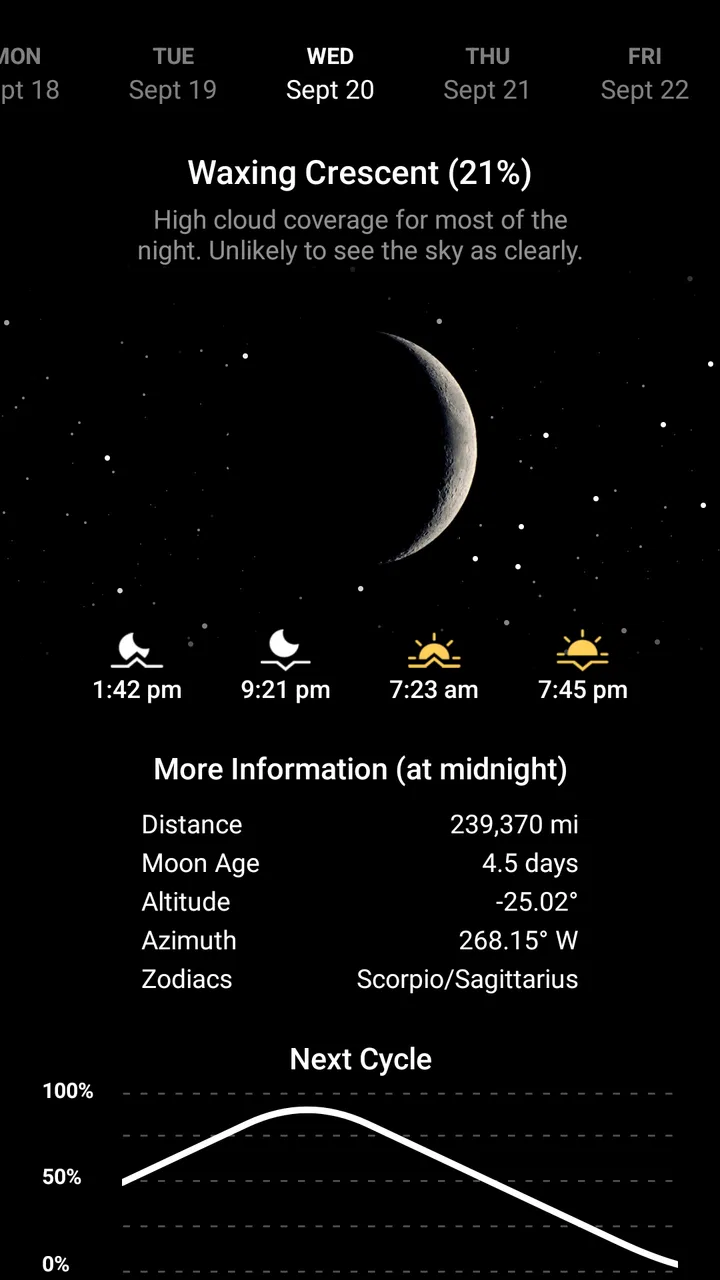
My Moon Phase Pro is a moon-tracking application designed to show the current lunar phase, upcoming phases, moonrise and moonset times, and other useful lunar information. It is aimed at casual users, photographers, gardeners, skywatchers, and anyone interested in planning activities around the Moon. The app presents this information in a simple, visual format that is generally easy to understand.
02What features are included in My Moon Phase Pro?
The app typically provides a visual lunar calendar, details about the current Moon phase, illumination percentage, moonrise and moonset times, and dates for future full and new moons. Depending on the device and version, it may also include notifications, location-based calculations, weather information, and details about lunar events. Before downloading, check the current store listing because features can vary between updates and platforms.
03Does My Moon Phase Pro require my location?
My Moon Phase Pro can use your location to calculate accurate moonrise, moonset, and lunar visibility information for your area. You may usually select a location manually instead of granting continuous location access, which is useful if you prefer greater privacy or want to plan observations elsewhere. Location availability and permission settings can differ between Android and iOS, so review them during setup.
04Is My Moon Phase Pro free to use?
The “Pro” version is generally offered as a paid app or as a premium edition, although pricing, promotions, and included features may differ by store, country, and operating system. Some versions may avoid advertising or unlock information unavailable in a basic edition. Always check the Google Play or App Store page for the current price, in-app purchases, subscription terms, and refund conditions before installing.
05Who would benefit most from downloading My Moon Phase Pro?
My Moon Phase Pro is useful for people who want a quick and convenient way to follow the lunar cycle without consulting astronomy websites or calendars. Photographers can use it to plan night shoots, while travelers, gardeners, anglers, and amateur astronomers may appreciate the timing information. It is not a replacement for professional astronomical software, but it is practical for everyday lunar planning.
Pros
- Detailed lunar calendar with moon phases
- illumination
- and rise/set times.
- Useful notifications help you prepare for upcoming full and new moons.
- Clean interface makes daily moon information easy to check.
- Includes moon position and visibility details for planning observations.
- Pro version removes ads for a more comfortable viewing experience.
Cons
- Some advanced astronomy details may be overwhelming for casual users.
- Accuracy of times depends on correct location and device settings.
- Limited value if you rarely follow lunar cycles or observe the sky.
- The app focuses on the Moon and lacks broader stargazing features.
- Some information may require scrolling through several calendar screens.

My Moon Phase Pro
Gallery